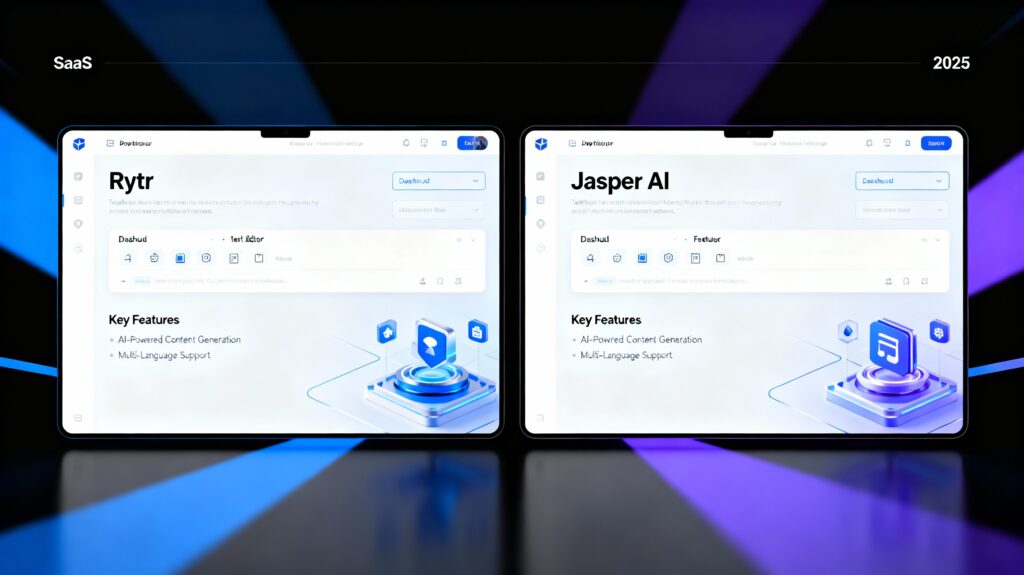


Rytr vs Jasper (2026): Which AI Writing Tool Is Better for Businesses?
Artificial intelligence has become an essential part of modern content creation, and by 2026 AI writing assistants are an indispensable tool for businesses. In this environment, two of the most discussed tools are Rytr vs Jasper. This comparison will explore how Rytr vs Jasper stack up in terms of capabilities, features, pricing, and use cases. We target business owners, marketing teams, and content strategists seeking an in-depth, independent analysis of these AI tools.
Today’s businesses generate a staggering amount of written content: blog posts, social media updates, ad copy, emails, and more. Tools like Rytr vs Jasper promise to automate parts of this process by generating high-quality text at scale. Companies rely on AI writers to boost productivity and meet demanding schedules. By framing this clearly as a comparison of Rytr vs Jasper, we’ll determine which is better suited to different business needs in 2026. Generative AI models have improved dramatically, so both Rytr vs Jasper now produce output that often rivals human writing in fluency and coherence. Despite these advances, the two platforms follow slightly different design philosophies: Rytr vs Jasper approaches diverge, with Rytr emphasizing user-friendly simplicity and Jasper offering deeper customization and more control. Understanding these core philosophies will guide our evaluation.
👉 Before we continue, you should know this: Rytr is currently offering one of the best-value AI writing plans on the market.
Don’t miss out — check Rytr’s latest deals here
Rytr vs Jasper each have built a strong following in the AI content arena. Rytr, often praised for its affordability, focuses on straightforward tasks and rapid output. Jasper, on the other hand, positions itself as an enterprise-grade solution with advanced collaboration and workflow features. By analyzing both tools side by side, we will find out which one makes more sense for tasks like long-form articles, marketing copy, or team collaboration. This introduction sets the stage for a detailed look at Rytr vs Jasper features, performance, and value. In short, this Rytr vs Jasper comparison will reveal which tool is the better fit for different business needs.
Rytr vs Jasper: Quick Comparison Summary
- Overview: Rytr vs Jasper are leading AI writing tools with different focuses. Rytr emphasizes simplicity and affordability, while Jasper emphasizes advanced features and enterprise readiness. In comparing Rytr vs Jasper, this is a key distinction.
- Best for: Rytr is best for solo entrepreneurs, small teams, and content creators who need fast content on a tight budget. Jasper is best for marketing teams, agencies, and larger organizations that require a powerful, collaborative platform.
- Content & Workflow: Both tools can generate quality text, but Jasper often excels with long-form and nuanced content. Rytr vs Jasper both handle short-form tasks well, but Jasper adds extra context controls, SEO integrations, and more flexible workflow options.
- Ease of Use: Rytr vs Jasper differ significantly in usability. Rytr offers a streamlined, beginner-friendly interface that new users find intuitive. Jasper includes many advanced tools (like robust editors, templates, and an AI assistant), which come with a steeper learning curve.
- Pricing: In the Rytr vs Jasper comparison, Rytr’s entry-level plans are significantly more affordable, making it attractive for budget-conscious users. Jasper’s plans cost more but include higher word limits, multiple team seats, and the latest AI engines.
- Verdict: In the Rytr vs Jasper debate, small budgets and quick content needs lean toward Rytr. For comprehensive content strategies, team collaboration, and advanced customization, Jasper’s robust capabilities often justify the extra cost.

Rytr vs Jasper: What Is Rytr?
Rytr is an AI content generation platform positioned as an accessible, budget-friendly writing assistant for businesses. In 2026, Rytr’s core philosophy is focused on simplicity and speed. It is designed to let users produce drafts of marketing copy, blog content, social media posts, email campaigns, and more with minimal effort. The interface is straightforward: you enter a prompt or topic, pick a writing template (like blog intro, Facebook ad, or product description), and the AI generates text. Over time, Rytr has expanded to support dozens of content templates for common tasks (like blog intros, ads, and email drafts) and supports multiple languages for global teams, making it versatile for various markets.
In practical terms, Rytr is often used for short to medium-length writing tasks. Common use cases include drafting product descriptions, writing social media updates, generating ad headlines, or outlining blog posts. A typical workflow in Rytr might be: select a tone (e.g. friendly or professional), enter a few keywords or instructions, and let the AI produce an output. Businesses on tight schedules can use Rytr to rapidly prototype ideas before refining the output manually. In the Rytr vs Jasper context, Rytr’s approach is more formulaic and menu-driven, whereas Jasper provides a more flexible, freeform experience with deeper customization.
Rytr’s strengths lie in its ease of use and cost efficiency. It provides a gentle learning curve for beginners: the dashboard is uncluttered, the required inputs are minimal, and the tool generates results with a single button click. Even without technical expertise, a user can navigate Rytr and produce coherent text. In 2026, Rytr typically runs on a proven AI model (often based on GPT-3.5 or similar), delivering solid quality for everyday content. Rytr also includes handy features like quick text rephrasing, built-in grammar correction, and simple translation between supported languages. For teams working across regions, Rytr’s multi-language support is a notable advantage.
However, Rytr does have limitations. Its AI outputs can sometimes feel generic or repetitive, especially for highly creative or nuanced projects. In the Rytr vs Jasper comparison, Rytr might not dive as deep into context as Jasper can. Complex tasks that require a strong narrative voice, in-depth research, or specialized writing (like technical documentation) may require more human revision. Rytr also lacks some of the advanced features seen in Jasper: there is limited built-in SEO optimization, fewer workflow and collaboration tools, and little to no project management or branding controls. Many of Rytr’s design choices favor simplicity over complexity, which keeps it accessible but less powerful.
Ideal users for Rytr are solo entrepreneurs, freelancers, and small businesses that prioritize simplicity and budget. A content marketer working alone might choose Rytr to quickly draft marketing emails or blog intros during a busy day. A startup founder might use Rytr to generate ideas for social posts in multiple languages without a steep learning curve. In summary, Rytr (in the context of Rytr vs Jasper) offers a no-frills, cost-effective AI writer that excels at straightforward tasks. It may not match Jasper feature-for-feature, but it clearly embodies the budget-conscious approach in the Rytr vs Jasper comparison.
Ready to test Rytr yourself?
Many small businesses start with Rytr because it’s fast, simple, and incredibly cost‑effective.
If you’re thinking about trying it, now’s the best time — plans often change. Check the current offer here
Rytr vs Jasper: What Is Jasper?
Jasper (formerly known as Jarvis) is an AI writing platform built as a feature-rich, professional-grade assistant for content teams and agencies. In 2026, Jasper’s positioning centers on power and versatility: it is designed to handle complex writing workflows at scale. Unlike simpler tools, Jasper offers advanced modes of interaction, including an AI chat interface and customizable “recipe” commands that guide the AI with detailed instructions. It runs on the latest language models (often GPT-4 or equivalent), and even supports enterprise features like security controls and custom brand voices for consistent style.
Typical use cases for Jasper include long-form content like blog posts, articles, reports, and e-books, as well as complex marketing campaigns and sales copy. Content marketers use Jasper to draft entire articles from an outline, generate multiple ad copy variations in one session, or produce full email nurture sequences. Jasper’s built-in frameworks (such as AIDA or PAS) and extensive template library make it easy to create structured persuasive content quickly. With integrated SEO tools and content briefs, Jasper can optimize articles for search. The platform supports multi-step workflows and team collaboration with content folders and approval processes.
One of Jasper’s greatest strengths is its writing quality and flexibility. It excels at nuanced, high-quality content and preserves context over long documents. Jasper can switch tones effortlessly and maintain consistency, thanks to features like saved “brand voice” profiles and templated style guides. The user interface is packed with options: alongside the standard editor, Jasper offers an advanced “Boss Mode” interface where users type natural-language commands (for example, “Expand this paragraph in a friendly tone”). Jasper also provides dozens of content templates and an AI brainstorming assistant for ideation, ensuring writers never run out of directions to explore.
However, Jasper’s capabilities come with trade-offs. It can be more complex and expensive than simpler tools like Rytr. New users often face a learning curve mastering its many templates, commands, and settings. Its pricing is generally higher and tailored for businesses with larger content needs. Because Jasper offers so many features, some tasks can feel overwhelming: if you only need a quick headline or a short snippet, Jasper’s interface might seem heavier than necessary. In the Rytr vs Jasper comparison, Jasper’s outputs can sometimes sound overly formal or salesy unless the user fine-tunes the prompts. Users may spend more time tweaking the AI instructions to get the desired tone.
Ideal users of Jasper are marketing agencies, in-house marketing teams, and enterprises that produce content at scale. For example, a content agency handling multiple client accounts might use Jasper to manage a large editorial calendar and delegate tasks through Jasper’s collaboration tools. A tech company with a content-driven growth strategy could rely on Jasper to research and draft a blog series, then refine the output with its SEO integrations. Basically, Jasper (in the context of Rytr vs Jasper) targets the professional end of the spectrum, where businesses have the budget and content volume to justify its advanced feature set.
Rytr vs Jasper: Writing Quality Comparison
Long-Form Content
For long-form writing (like blog posts and articles), Jasper typically outperforms Rytr in cohesion and depth. Jasper’s advanced AI engine and project workflow allow it to maintain narrative flow across multiple paragraphs. Users can feed it an outline and receive a structured draft, complete with subheadings and logical transitions. In contrast, Rytr handles long content in smaller chunks. It can generate coherent paragraphs, but it may lose consistency if pushed too far. In practice, when writing a detailed article, Jasper often produces a more unified result with minimal editing, whereas Rytr might require stitching together multiple outputs to achieve a smooth flow.
Short-Form Content
When it comes to short-form content (like social posts, headlines, or brief ads), both Rytr and Jasper perform well. Rytr’s simplicity shines here: it can quickly generate concise copy with minimal input. Jasper, while also capable, may be more tool than you need for very short tasks. However, Jasper provides finer control over nuance even in short text; it can easily generate multiple variations or adopt subtle tones. In practice, Rytr vs Jasper both deliver solid short snippets, but Jasper can edge ahead by offering additional creativity and refinement when needed.
Marketing Copy
Marketing content covers ads, email campaigns, landing pages, and product descriptions. Jasper’s specialized marketing templates give it an edge here. It can frame copy using proven structures (like AIDA or PAS) and instantly produce variations of headlines or calls-to-action. This speeds up creating persuasive copy at scale. Rytr can produce marketing copy too, but it often requires more manual prompt engineering. A user might need to tweak instructions or iterate more times to reach the same level of polish. Overall, Jasper generally excels in marketing writing by delivering polished, ready-to-use copy faster, while Rytr handles basic marketing tasks adequately but with more user effort.
SEO-Focused Writing
For SEO-driven content, Jasper takes the lead thanks to its content planning and integration tools. Jasper allows users to build content briefs with target keywords and often connects with SEO platforms to suggest optimizations. Its long-form capabilities help naturally incorporate keywords and related phrases into the text. Rytr does not have built-in SEO guidance; it will include keywords if you specify them, but it won’t optimize the structure or density of the content. In a Rytr vs Jasper comparison, SEO specialists will likely favor Jasper’s integrated workflow for optimizing blog posts and web pages, because Jasper’s platform explicitly supports the SEO process.
Tone Consistency
Maintaining a consistent tone is easier with Jasper. It includes features like saved “brand voice” profiles and the ability to specify tone for each output. Once set, Jasper can keep style uniform across multiple pieces of content. Rytr offers basic tone options (such as “professional,” “casual,” or “witty”), but it does not have a system for a persistent brand voice. This means that in a long session, Jasper is more reliable at staying in character. Rytr vs Jasper in this area clearly favors Jasper: businesses with strict brand guidelines will appreciate Jasper’s advanced tone control.
Output Control
Output control refers to how much you can steer or refine the AI’s content after the initial generation. Jasper provides more tools for control. Users can click buttons to expand, shorten, or rephrase sections, and use commands to refine output on the fly. Jasper also offers an iterative “chat” mode where you can give follow-up instructions (e.g. “Make this paragraph more concise”). Rytr’s controls are simpler: you get a result and can regenerate or tweak the prompt, but there are fewer built-in editing features. In the Rytr vs Jasper evaluation, Jasper again wins on content control, offering users more ways to refine and edit generated text interactively.
Rytr vs Jasper: Features & Templates Comparison
Content Templates
Both Rytr and Jasper offer a library of templates to jumpstart content creation. Rytr provides a solid set of out-of-the-box templates (on the order of a few dozen) for common tasks like blog intros, social posts, ad copy, email subject lines, and more. Each template guides you to enter a brief or keywords and returns targeted output. Jasper, in contrast, offers a much larger template library and even multi-step “recipes.” It includes everything from marketing frameworks (AIDA, PAS, etc.) to brainstorming tools for blog ideas. Jasper’s templates can be chained together – for example, you might generate a blog outline, then have Jasper expand each bullet into paragraphs.
Customization & Brand Voice
Customization is another area of contrast. Rytr lets you choose a writing tone (formal, casual, etc.) and supports multiple language inputs, which is useful for reaching different audiences. However, it does not have persistent brand profiles or advanced setting tweaks. Jasper, meanwhile, offers in-depth customization. You can define a custom “brand voice” once with specific attributes and Jasper will apply it across all outputs. Jasper also allows fine-tuning prompts directly in its editor via natural-language commands. In the Rytr vs Jasper comparison, Jasper’s customization tools are much richer, making it easier to enforce brand consistency.
Workflow Support
Workflow tools help organize projects and content pipelines. Rytr keeps this simple: you typically generate content in one session and then export it to your own document editor. It does not include built-in content calendars or task management. Jasper, on the other hand, includes workflow-oriented features. You can create content briefs that combine outlines, SEO keywords, and research notes. Jasper’s interface often supports project folders, version history, and even task assignments for team collaboration. It may also integrate with SEO platforms for real-time keyword suggestions and optimization. Essentially, Jasper provides an end-to-end writing workflow, whereas Rytr is focused purely on generation.
Team Collaboration
Regarding team collaboration, Rytr offers only basic multi-seat plans with limited collaboration. In a typical Rytr plan you can add users, but there are no advanced role permissions or built-in document sharing. Jasper is built with teams in mind: its plans allow multiple users with various roles, and team members can share content drafts within the workspace. Jasper often includes comment threads or approval workflows so marketers can review and iterate on drafts together. In the Rytr vs Jasper scenario, Jasper has a clear advantage for teams; Rytr is more geared toward individual users or very small teams.
Rephrase and Expand Features
Both tools allow you to refine generated text, but Jasper provides more built-in editing helpers. Jasper’s editor typically has buttons or commands for “Expand,” “Shorten,” or “Paraphrase” on selected text segments. It also offers an interactive chat where you can ask the assistant to rephrase or improve content. Rytr, in comparison, relies mostly on re-running a generation or tweaking the prompt to alter output. It may have a simple rephrase tool, but it lacks the real-time editing widgets that Jasper offers. In practice, Rytr vs Jasper comes down to ease of use: Jasper offers more immediate control for refining text, while Rytr requires a manual adjust-and-regenerate approach.

Rytr vs Jasper: Ease of Use & Learning Curve
Rytr is generally straightforward and beginner-friendly. Its interface is clean and uncluttered, presenting only the essential inputs (topic, tone, length, etc.). Even first-time users can start generating content with minimal instructions. Onboarding is quick: Rytr walks you through the basics of selecting a use case and entering a short brief. In contrast, Jasper’s interface is more complex. It offers various editing modes, many setting options, and even a separate AI command bar. A new user may need some time to get acquainted with these features, although Jasper provides tooltips and tutorials for guidance.
Performance-wise, both platforms generate text in seconds, but Rytr’s simpler design can feel snappier in day-to-day use. Jasper’s richer feature set sometimes means more menu navigation and slight delays as you switch modes or open tools. For example, toggling between content templates and the AI assistant in Jasper may involve several clicks. In terms of workflow, Rytr expects a straightforward prompt-and-generate approach, while Jasper is built for iterative prompting and multi-step projects, which can be powerful but requires patience.
In practice, a beginner will usually find Rytr easier to pick up. A user without any AI experience can produce useful content within minutes of signing up. Jasper offers more power but demands more investment in learning. In a Rytr vs Jasper comparison of ease of use, Rytr clearly wins on a shallow learning curve and immediate results, whereas Jasper requires more effort to master but delivers greater capabilities once learned. This reflects their design goals: Rytr prioritizes quick adoption for simple tasks, and Jasper prioritizes flexibility for advanced users.
Rytr vs Jasper: Business & Marketing Use Cases
Blogging
For blog writing, both tools can help, but Jasper often excels at producing long posts and outlines. Marketers using Jasper can leverage its content planning and SEO integration to draft comprehensive articles. Jasper can expand an outline into full paragraphs and suggest related ideas. Rytr can quickly generate blog intros and outlines, but longer posts may require the user to piece together multiple Rytr outputs. In the Rytr vs Jasper context, Jasper is generally better for full blog posts, whereas Rytr is more suitable for shorter write-ups or outlines.
SEO Content
When the goal is search engine optimization, Jasper’s advantage comes from its specialized tools. Jasper can create content briefs, suggest long-tail keywords, and adjust writing to include them naturally. Its long-form capacity also helps meet the word counts often needed for SEO. Rytr has no dedicated SEO features, so it relies on the user to manually include target keywords. In a Rytr vs Jasper comparison for SEO content, specialists will likely favor Jasper’s integrated workflow for optimization tasks.
Ads and Landing Pages
Creating ad copy and landing page content is a common use case. Rytr can generate catchy headlines, taglines, and short ad variants quickly, which is useful for A/B testing ideas on the fly. Jasper, with its marketing frameworks and tone controls, can also produce high-quality ad copy and landing page text, often delivering multiple polished versions at once. Its strength is in iteration: Jasper can refine an existing ad copy or explore different angles on a theme. In practice, Rytr vs Jasper both handle ads and landing pages competently, but Jasper may deliver more polished results thanks to its marketing templates.
Email Marketing
For email campaigns, Jasper tends to shine by generating entire email sequences or persuasive sales emails with structure. It can maintain a consistent tone across multiple messages. Rytr can write individual emails or subject lines effectively, but stitching together a full campaign requires manual effort. Jasper’s ability to maintain context across messages and use specialized email templates (like product announcements or newsletters) is beneficial. In a Rytr vs Jasper comparison for email marketing, businesses looking to automate newsletters or drip campaigns may find Jasper’s features more supportive.
Social Media
Social media content usually means short posts or captions. This is where Rytr’s speed and simplicity are very handy. In the Rytr vs Jasper comparison, Rytr can quickly generate tweets, Facebook updates, LinkedIn posts, and even multi-language captions. Jasper does the same, and its AI can mimic brand voice across different platforms. The difference is subtle: Rytr lets a busy manager crank out posts quickly, while Jasper can ensure a consistent style and perhaps inject greater creativity. Both tools cover social media well, so there is often little difference in capability here.
Internal Documentation
For internal use cases like knowledge base articles, manuals, or company communications, Jasper’s advanced features are often more than needed. Rytr can draft straightforward help topics or internal notices without much setup. Jasper could write internal docs too, but its premium features (like brand voice and SEO tools) are less important for internal content. In a Rytr vs Jasper evaluation for documentation, Rytr may suffice for simple guides. However, if a company already uses Jasper for external content, it can leverage the same platform to produce internal content consistently.
Rytr vs Jasper: Pricing & Value for Money
When comparing Rytr vs Jasper in terms of pricing, it’s clear they target different segments. Rytr positions itself as the budget-friendly option. By 2026, Rytr typically offers an entry-level plan with a modest monthly fee (often the price of a few cups of coffee) that includes a reasonable word limit and access to all core features. There is often a free or lower-cost tier for very light use as well. Jasper’s pricing is higher: its entry-level plan costs several times more per month, reflecting its advanced AI (including GPT-4 access) and larger monthly quotas.
Looking at cost vs features, Rytr’s plans generally provide fewer words and user seats but include unlimited access to its template library. In contrast, Jasper’s plans include much higher word caps (often hundreds of thousands of words per month) and multiple team seats. Jasper’s higher cost is justified by the powerful features it includes (advanced AI models, SEO tools, and collaboration workflows) that Rytr’s lower-priced plans do not. In a Rytr vs Jasper comparison of value, Rytr is more cost-effective for small word volumes, whereas Jasper delivers greater value when its advanced capabilities and capacity are fully utilized.
Scalability for teams is another consideration. Rytr may offer simple team or agency plans, but the number of seats is usually limited to a handful of users. Jasper’s pricing is designed to scale with growth: its higher tiers allow dozens of user seats, and enterprise agreements can be negotiated for very large organizations. For a growing marketing department or agency, Jasper’s tiered pricing can accommodate expanding needs. A small startup with a limited budget might start with Rytr, but as content demands and team size grow, Jasper often becomes the more scalable choice.
Ultimately, the choice between Rytr vs Jasper comes down to value for money in context. Rytr delivers solid AI writing tools at a bargain price, making it strong value for solo creators or small businesses. Jasper costs more but provides extensive capabilities that can significantly boost efficiency and output for large-scale content production. Businesses should consider their content volume and feature requirements: for light to moderate use, Rytr often wins on budget, but for intensive use with complex needs, Jasper’s advanced feature set may offer a higher return on investment despite the higher cost. In conclusion, always evaluate Rytr vs Jasper through the lens of your specific use case.
Rytr vs Jasper for Different User Types
- Solo Creators: Solo bloggers or small business owners often prefer Rytr. They benefit from Rytr’s low cost and ease of use for everyday content. However, if a solo creator needs to produce very polished articles or handle large projects alone, Jasper might be worth the investment. In a Rytr vs Jasper scenario, solo users will usually start with Rytr for simple tasks and only upgrade to Jasper if their needs outgrow it.
- Freelancers: Freelance writers or marketers have varied needs. Budget-conscious freelancers might choose Rytr for quick social posts and basic copy. Others who manage multiple clients or need to deliver standout content may opt for Jasper’s higher-quality output and templates. For freelancers, the choice in Rytr vs Jasper often comes down to whether the slight boost in writing quality (with Jasper) can command better rates from clients.
- Small Businesses: Small businesses face a balance of budget and capability. Many small teams start with Rytr because it covers most common needs at a lower price. Rytr can handle routine marketing emails, ads, and blog drafts efficiently. As a business grows, some may switch to Jasper to gain access to advanced features like collaboration, workflow tools, and SEO assistance. In the Rytr vs Jasper comparison, a small business might use Rytr initially and consider Jasper once content needs become strategic and resources allow.
- Marketing Agencies: Agencies typically favor Jasper. With multiple clients and high content volume, agencies need robust team tools. Jasper’s collaboration features and extensive template library help agencies produce diverse content efficiently. Rytr may serve as a cost-effective backup or quick idea generator, but agencies often rely on Jasper for the bulk of client work. In the Rytr vs Jasper context, agencies usually lean heavily toward Jasper for its professional-grade capabilities.
- Enterprise Teams: Large enterprises with dedicated content departments often choose Jasper. They benefit from enterprise-level support, role management, brand controls, and deep integrations that Jasper provides. Rytr is unlikely to meet complex enterprise requirements on its own. In an enterprise context of Rytr vs Jasper, Jasper is almost always the preferred choice due to its scalability, security options, and comprehensive feature set.
Rytr vs Jasper: Pros and Cons
Rytr: Pros
- Affordable pricing and generous word limits for entry-level plans.
- Simple, clean user interface (low learning curve).
- Suitable for quick short-form and medium-length content creation.
- Supports many languages and a variety of useful templates.
- Rapid generation speed for everyday tasks.
Rytr: Cons
- Limited advanced features (no built-in SEO tools, brand templates, or chat mode).
- Output quality can be generic or repetitive; often requires editing for high polish (a limitation more evident in a Rytr vs Jasper comparison).
- Basic tone controls without persistent brand voice settings.
- Team collaboration features are minimal.
- Not ideal for very long or highly specialized content without significant manual editing. This limitation becomes clear when doing a Rytr vs Jasper side-by-side.
Jasper: Pros
- Very powerful AI (often running GPT-4) producing high-quality, nuanced content.
- Extensive template library including marketing frameworks and multi-step recipes.
- Advanced customization (brand voice profiles, command-based editing).
- Built-in SEO tools and content optimization integrations.
- Robust collaboration features for teams and enterprises.
- Scales to high word counts and multiple user seats.
- Continuous feature updates (e.g. AI chat mode, document research tools).
Jasper: Cons
- Higher cost (more expensive plans and usage).
- Steeper learning curve due to many features and modes.
- Can feel complex or overwhelming for simple tasks.
- May produce overly formal or generic text if not guided carefully.
- Requires manual setup of brand tones to achieve consistency.
- Overkill for very basic or occasional writing needs.

Rytr vs Jasper (2026): Final Verdict
Deciding between Rytr vs Jasper comes down to aligning each tool’s strengths with your priorities. If your main goal is cost-effectiveness and ease of use for everyday content, Rytr is often the smarter choice in 2026. It delivers a capable writing assistant at a fraction of the price of Jasper, making it ideal for solo entrepreneurs, small teams, and straightforward projects. On the other hand, if you represent a marketing agency, growing startup, or enterprise that demands the highest quality, advanced workflows, and collaborative features, then Jasper is likely worth the investment. Jasper’s more sophisticated AI, extensive template library, and team tools justify its higher cost for large-scale content operations.
In practice, many businesses will use both tools in tandem or start with one and upgrade as needs change. For example, a small business might begin with Rytr to handle routine copy, and later adopt Jasper for launching a major marketing campaign or scaling content production. Weigh factors such as monthly writing volume, required writing quality, and collaboration requirements. Remember that Rytr vs Jasper is not an absolute competition: each has carved out a niche. Ultimately, our expert perspective in the Rytr vs Jasper analysis is that neither tool is universally “better” in 2026; rather, the better choice depends on your team size, budget, and content goals. Businesses should match their requirements to each platform: choose Rytr for simplicity and value, or choose Jasper for power and expansiveness. In conclusion, always evaluate Rytr vs Jasper through the lens of your specific use case.
⚡ If you’re leaning toward Rytr, don’t wait.
It’s one of the few AI writers in 2026 that still offers powerful features at a low entry price.
See today’s Rytr pricing before it changes
FAQ
Is Rytr better than Jasper for small businesses?
For many small businesses, Rytr’s lower cost and simplicity make it a practical choice in the Rytr vs Jasper context. Rytr can handle common content needs (emails, social posts, basic blog drafts) without much expense. Jasper, however, offers more advanced features that might be unnecessary if the business has modest content volume. In a Rytr vs Jasper comparison, we often see small businesses start with Rytr to save budget. If they later need more collaboration or high-volume output, they can consider Jasper.
Which is more cost-effective: Rytr vs Jasper?
When considering Rytr vs Jasper cost-effectiveness, Rytr is generally more cost-effective for limited budgets and moderate use. Its plans offer basic AI writing features at a fraction of Jasper’s cost. Jasper’s plans cost more, but include advanced AI, higher word limits, and team seats. If you produce light to moderate content, Rytr typically offers better bang for the buck. If your team churns out large volumes of long or complex content, Jasper’s investment can pay off by increasing efficiency. So in the Rytr vs Jasper comparison, Rytr often wins on pure cost for everyday use, but Jasper delivers more value when its extra capabilities are needed.
Can Rytr replace Jasper for SEO content?
Rytr can help with SEO content to some extent, but in the Rytr vs Jasper comparison, Jasper is typically stronger in this area. Jasper has built-in SEO tools and content brief features that guide keyword usage and structure. It can integrate target keywords naturally and ensure content is optimized. Rytr, on the other hand, lacks dedicated SEO workflows; it will include keywords only if you specifically prompt it. If your strategy relies on in-depth SEO optimization, Rytr by itself is not a full replacement for Jasper’s focused SEO capabilities.
Is Jasper worth the price compared to Rytr?
Whether Jasper is worth the extra cost depends on your needs and how you compare Rytr vs Jasper. Jasper is more expensive but offers advanced AI, team features, and SEO tools that Rytr lacks. If you require high-quality long-form content, collaboration, or content optimization, Jasper can justify its price through productivity gains. If your needs are simpler, Rytr can be sufficient. Consider how often you will leverage Jasper’s extra features. If you will use them frequently, Jasper will likely be worth it; if not, Rytr may deliver adequate performance for much less money.
Rytr vs Jasper for long-form blog posts?
For long-form blog posts, Jasper generally produces better results. Its AI is better at maintaining context and structure over thousands of words, and it offers tools to outline and expand content systematically. Rytr can generate parts of a blog post, like introductions or sections, but it may require more user effort to ensure cohesion. In direct Rytr vs Jasper comparisons, Jasper is the preferred choice for writing full-length articles with minimal editing.
Rytr vs Jasper for marketing teams?
Marketing teams often benefit more from Jasper’s capabilities. In the Rytr vs Jasper comparison, marketing teams often find Jasper’s collaboration features, content organization, and marketing templates very useful for team workflows. It allows multiple users to work together in one platform, which is important for agencies or corporate marketing departments. Rytr can be used by marketing teams too, but it is more limited in multi-user features. Overall, teams typically lean toward Jasper because it was designed with collaborative marketing use cases in mind.
Which tool scales better in 2026?
Jasper scales better for large operations. Its infrastructure and pricing tiers are built to accommodate growing content demands and team sizes. Jasper can handle very high output volumes and many user seats. Rytr scales to an extent but is mainly aimed at solo users or small teams. In a direct Rytr vs Jasper scale comparison, Jasper is the clear winner for enterprise-level scalability. However, Rytr scales well enough for solo entrepreneurs and small companies on a tight budget.
Rytr vs Jasper: which one should beginners choose?
Beginners often find Rytr easier to start with in the Rytr vs Jasper debate. Its simple interface and straightforward template system allow new users to generate useful content almost immediately. Jasper, while more capable, has a steeper learning curve that can overwhelm someone new to AI writing. From a beginner’s perspective, Rytr is usually the recommended starting point. Once comfortable, a beginner can explore Jasper if they need more advanced capabilities. Overall, Rytr tends to be the less intimidating option for those just getting started. As part of the final Rytr vs Jasper analysis, beginners often start with Rytr and potentially move to Jasper later if needed.
Want to read more about rytr? Rytr review